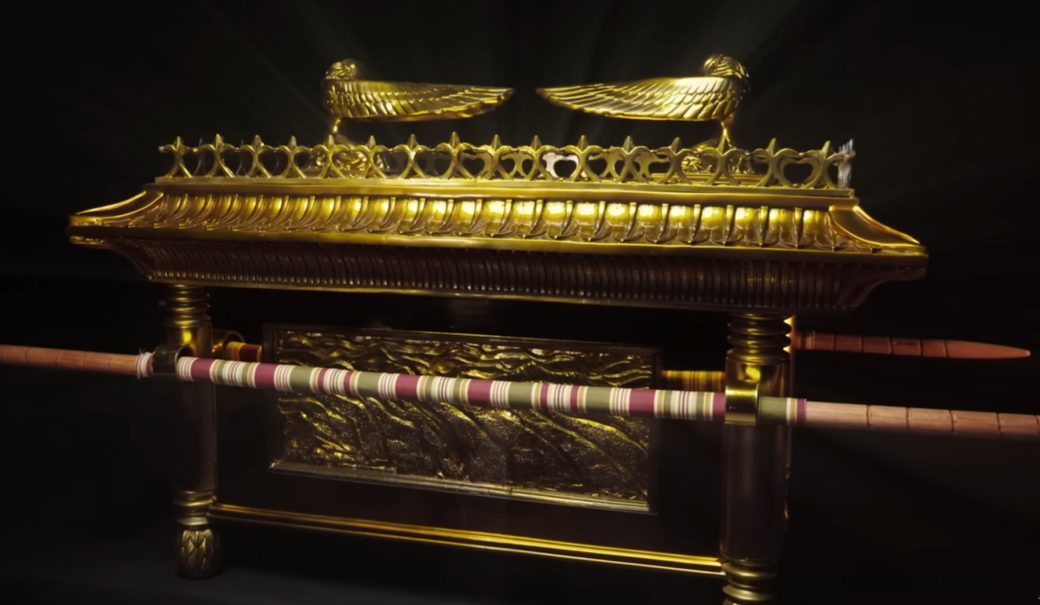
The Ancient Object That Still Sparks Curiosity
Few artifacts inspire as much awe and speculation as the Ark of the Covenant. Mentioned in the Hebrew Bible, it was said to hold the stone tablets of the Ten Commandments — the physical representation of a divine agreement between God and the Israelites. For believers, it wasn’t merely an object; it was the seat of God’s presence, a sacred link between heaven and earth.
Across centuries, the Ark’s mystery only deepened. Archaeologists, theologians, and dreamers have all sought its traces. Even those with no religious faith find themselves drawn to the story: a golden chest, carried through deserts and battles, vanishing from history without a trace. It’s a tale where faith, power, and myth intertwine.
How the Ark Was Described and Built
According to the Book of Exodus, the Ark was constructed under the direct instruction of God, delivered to Moses atop Mount Sinai. It was made of acacia wood and overlaid with pure gold, both inside and out. Its lid, known as the “mercy seat,” featured two cherubim with outstretched wings facing each other — a symbolic throne for the divine presence.
The Ark was carried using poles, as touching it directly was forbidden. Its portability symbolized both holiness and fragility: a reminder that divine power was never to be taken for granted. Biblical descriptions present it not as an idol, but as a manifestation of covenant — an idea rather than a possession.
The Ark represented both the danger and the intimacy of divine presence — a paradox humanity has wrestled with ever since.
The Role It Played in Israelite Culture and Faith
For the Israelites, the Ark was more than a relic. It led them through the wilderness, across the Jordan River, and into battle. When the Ark was present, victory often followed; when it was lost, despair set in. It resided in the inner sanctum of the Tabernacle, and later, the Temple of Solomon — accessible only to the high priest, and only once a year on the Day of Atonement.
The Ark embodied both reverence and fear. Stories tell of people struck down for touching it or even glancing upon it unworthily. It was at once a comfort and a warning — divine proximity with mortal consequence. In that duality lies much of its enduring power.
The Mysterious Disappearance — And Endless Theories
Sometime after the Babylonian conquest of Jerusalem in the 6th century BCE, the Ark vanished from record. Did it burn? Was it hidden by priests? Transported to Ethiopia, as some Ethiopian Orthodox traditions claim? Scholars and treasure hunters alike have offered countless theories, but no proof.
Archaeologists have searched in Israel, Egypt, and even sub-Saharan Africa. Others insist it’s symbolic — not a lost object, but a lost understanding of faith and responsibility. Still, the absence itself fuels fascination. A mystery unconfirmed is a story that never dies.
How Pop Culture Revived the Legend
In the 20th century, the Ark found new life through pop culture. “Raiders of the Lost Ark” turned it into an icon of adventure and mystery, while novels and documentaries have kept the search alive. The real magic of the Ark’s cinematic rebirth lies in how it bridges the ancient and the modern: we still crave objects that connect us to something greater than ourselves.
Whether on film or in folklore, the Ark’s pull endures. It represents not only divine power, but also the human longing to touch the untouchable — to bridge history, belief, and imagination.
Why the Ark Still Captures the Modern Imagination
The Ark of the Covenant stands at the intersection of myth and memory. In a secular age, it reminds us of the human hunger for meaning and mystery. Perhaps it’s not the Ark itself we’re searching for, but what it represented: a moment when people believed they could hear the voice of God.
That’s why, even today, its story still moves between temples, libraries, and movie screens — because it touches something universal. The Ark may be gone, but the need for connection, reverence, and awe remains as alive as ever.