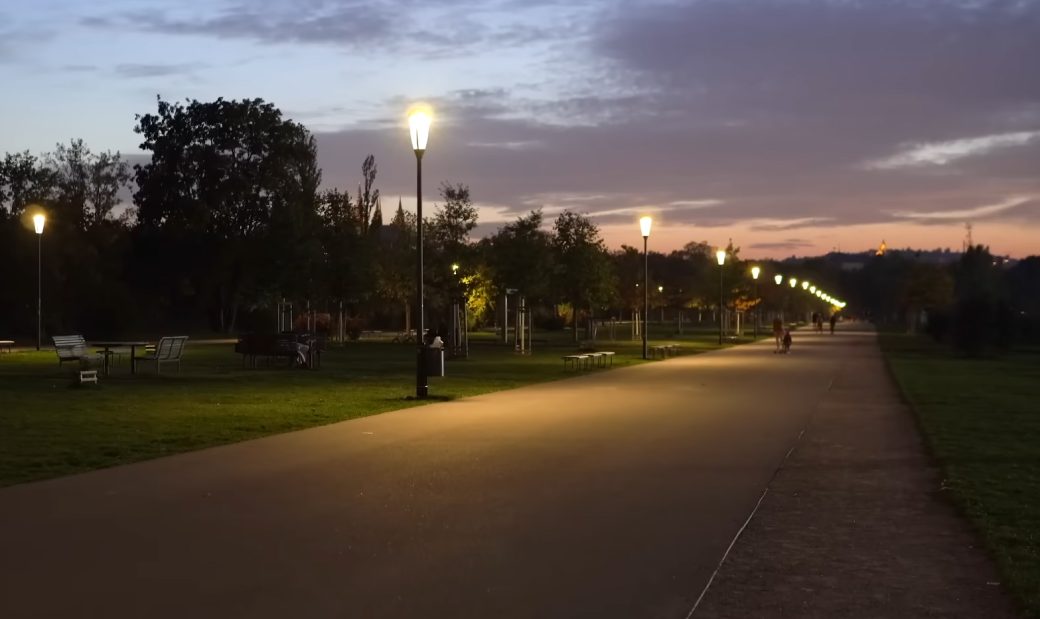
Why Street Lighting Doesn’t Follow Perfect Geometry
When you walk or drive through a city, it’s easy to assume street lamps should be spaced evenly, like points on a grid. In practice, that almost never happens. Even in cities with strict infrastructure standards, lighting lines often look irregular — closer in one spot, spread out in another. And there’s a straightforward reason for that: real streets rarely allow perfect mathematical symmetry.
Civil engineers work with the physical world, not a blank blueprint. Road curvature, slopes, pedestrian crossings, and intersections all change the lighting requirements. A gentle bend requires more illumination on the inside curve. A slope changes the effective reach of a lamp. A crossing needs brighter, denser lighting for safety. Every deviation modifies how far apart poles can be without leaving dark spots.
Standards such as the CEN EN 13201 (Europe), the IES RP-8 (North America), and AS/NZS 1158 (Australia and New Zealand) define required light levels for different road types. They do not require perfect spacing — only adequate illumination. So engineers adjust placement to achieve lighting uniformity, even if the poles end up looking “uneven.”
How Traffic Engineering Standards Actually Work
Light spacing is determined by a concept called photometric performance. Instead of telling cities to put lamps every X meters, modern standards specify how much light must reach the pavement and how evenly it must be distributed. This creates flexibility — and often irregularity.
For example, the Illuminating Engineering Society’s RP-8 guideline used widely in the U.S. and Canada focuses on luminance uniformity, veiling luminance, and minimum maintained levels. If a brighter LED fixture replaces an older one, spacing can be increased. If a dimmer model is installed, poles may need to be closer. Many cities have mixed generations of fixtures, producing inconsistent distances.

Vehicle speed plays a role too. Faster roads require higher visibility, which may prompt tighter spacing approaching intersections or curves. On slower residential streets, wider spacing may be acceptable. What looks irregular from the sidewalk is often a deliberate engineering choice shaped by safety studies and lighting simulations.
When Safety Requires Breaking the Pattern
Even if planners aim for a pattern such as opposite-side placement or staggered placement, safety needs can override the geometry. A pedestrian crossing, school zone, or mid-block bus stop may require a brighter patch. Engineers sometimes add an extra pole or move an existing one, producing asymmetry.
Street corners are especially complex. Intersections generate shadows from buildings, signs, and trees. Standards frequently require additional illumination to ensure drivers can see pedestrians entering the crossing. This often forces a pole into what seems like an “awkward” location, even if it perfectly follows the safety model.
No global standard requires poles to look evenly spaced — only to achieve safe, uniform lighting on the ground.
In other words, the street is designed for visibility, not symmetry. And those two goals rarely align.
Urban Constraints: Buildings, Trees, Soil, Utilities
One of the biggest reasons for irregular pole spacing is simple: urban environments are full of obstacles. Every pole must avoid underground gas lines, water mains, fiber-optic cables, electrical ducts, and drainage structures. These utilities often run in unpredictable ways beneath older streets, and excavation records can be incomplete. If a pole cannot be placed at the “ideal” point because utilities block installation, it has to shift.

Above-ground conflicts matter too. Mature trees can block light or conflict with pole placement. Cities often choose to preserve the tree and shift the light instead. Driveways, wheelchair ramps, outdoor seating zones, and bus shelters further limit available pole locations.
Geology sometimes interferes: soil instability, bedrock near the surface, or areas prone to erosion may require the pole’s foundation to be moved to a more stable location. Most of these factors are invisible to passersby, but they heavily influence spacing.
Modern LED Retrofits and Why They Create Irregularity
Over the last decade, thousands of cities in Europe, North America, and Australia have replaced older sodium-vapor or metal-halide lamps with LEDs. LED optics distribute light differently, often more directionally. Some LED fixtures can illuminate a wider area, allowing poles to be spaced farther apart — but retrofits usually reuse existing poles rather than relocating them.
This leads to a common situation: the new illumination pattern no longer matches the old pole geometry. Some areas become brighter, some dimmer, and cities adjust placement only when necessary. Mixing old poles with new optics produces the irregular patterns many people notice today.
Additionally, when a pole needs replacement — for example after a collision or corrosion — it may be installed slightly differently due to updated safety clearances or new underground constraints. Over decades, these micro-adjustments accumulate, producing a visibly uneven line.
Energy, Budget, and Maintenance Factors That Shape Placement
Lighting networks are expensive to maintain, and many municipalities try to reuse as much existing infrastructure as possible. Replacing or relocating a pole can cost several thousand dollars depending on region. Because of this, engineers often keep poles where they are unless lighting levels fall below regulatory thresholds.
Some cities reduce the number of poles during LED upgrades to save on energy and maintenance. When certain poles are removed but others remain, the spacing becomes visibly inconsistent. Budget cycles also matter: a street may be partially upgraded one year and finished years later, leaving mismatched spacing in the meantime.
Maintenance priorities — such as covering dark corners with an added pole — can introduce new irregularities. From a technical perspective, the goal is always to maintain lighting quality, not geometric perfection.
What Research Says About Optimal Lighting Distance
Scientific studies consistently show that uniformity of light on the pavement is more important for visibility than pole spacing itself. Research from the Illuminating Engineering Society, the European Committee for Standardization (CEN), and multiple transportation agencies highlights that spacing only matters insofar as it affects light levels and contrast detection.
Different lamp types have different effective ranges. High-pressure sodium, once common, spreads light widely but unevenly. LED fixtures produce more controlled beams, often requiring new photometric designs. Because each technology behaves differently, cities with mixed lighting generations naturally exhibit irregular spacing.
In short, irregular spacing is not a flaw — it’s a byproduct of engineering constraints, safety requirements, evolving technology, and decades of incremental upgrades.